Advanced Particle Transport Modeling and Radiation Dose Distribution Systems
Introduction to Particle Transport Modeling in Proton Radiation
Particle transport modeling represents a fundamental component of modern radiation physics and medical treatment engineering. It provides a mathematical and computational framework for investigating how energetic particles propagate through different materials, interact with atomic structures, and deposit energy within biological environments.
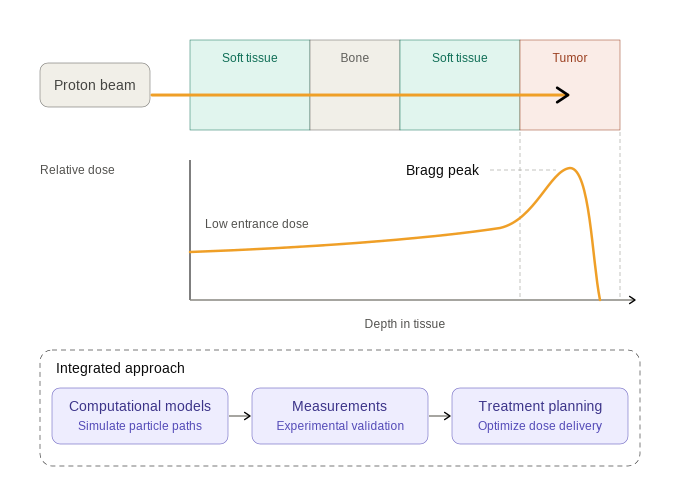
In proton-based cancer treatment, understanding particle transport is particularly important because the physical behavior of protons determines their penetration depth, spatial distribution, and energy deposition patterns.
The integration of computational modeling, experimental measurements, and advanced treatment planning techniques enables researchers to investigate complex radiation environments and improve the scientific understanding of dose distribution within heterogeneous tissues.
1. Fundamental Principles of Particle Transport
The transport of energetic protons through matter involves a sequence of physical interactions that progressively modify their energy and direction of propagation.
As protons travel through biological tissues, they interact primarily with atomic electrons and nuclei. These interactions produce energy loss, angular scattering, and, under certain conditions, secondary radiation.
The principal parameters governing particle transport include:
Initial particle energy.
Material density and elemental composition.
Particle stopping power.
Interaction cross sections.
Energy loss distribution.
Angular scattering characteristics.
Penetration range.
Secondary particle production.
Understanding these parameters is essential for developing accurate mathematical representations of proton propagation in complex biological environments.
2. Mathematical Modeling of Proton Propagation
Mathematical modeling provides a theoretical foundation for describing particle movement and energy transfer through matter.
The transport of particles can be represented through differential equations that account for changes in particle position, direction, and energy.
These models consider the probability of different interactions occurring along the particle trajectory and evaluate how these interactions influence the overall radiation field.
Continuous energy loss models describe the gradual reduction in proton kinetic energy during propagation. Stochastic approaches additionally consider fluctuations in energy deposition and variations in individual particle trajectories.
Combining these mathematical approaches allows researchers to investigate the physical behavior of proton beams under different irradiation conditions.
3. Monte Carlo Simulation of Particle Interactions
Monte Carlo simulation is one of the most widely used computational approaches for investigating radiation transport.
This method uses probability distributions and repeated random sampling to reproduce the sequence of physical interactions experienced by individual particles.
Each simulated proton is assigned an initial energy and trajectory. As it propagates through a defined material, the computational model evaluates possible interactions, energy losses, scattering events, and secondary particle production.
By simulating large numbers of particle histories, researchers can estimate the spatial distribution of deposited energy within a target volume.
Monte Carlo modeling is particularly valuable when investigating heterogeneous materials, complex geometries, and radiation environments involving multiple interaction mechanisms.
4. Proton Range and Penetration Depth
Proton range refers to the distance that a proton travels through a material before losing most of its kinetic energy.
Its value depends primarily on the initial particle energy and the stopping properties of the material.
The penetration depth is an important parameter in proton treatment planning because it determines where the majority of the incident particle energy will be deposited.
Several physical factors can influence proton range:
Variations in tissue density.
Differences in elemental composition.
Changes in material thickness.
Energy fluctuations among incident particles.
Multiple scattering events.
Anatomical heterogeneity.
Accurate range estimation is therefore essential for understanding the relationship between beam characteristics and energy deposition within biological tissues.
5. Stopping Power and Energy Loss Mechanisms
Stopping power describes the average energy lost by a charged particle per unit distance traveled through a material.
For protons, electronic interactions represent the dominant contribution to energy loss over many clinically relevant energy ranges.
Nuclear interactions and scattering processes also contribute to the overall behavior of the particle beam.
Stopping power is influenced by the physical and chemical properties of the irradiated material, making it an important parameter in computational radiation transport models.
Accurate stopping power characterization supports the calculation of proton penetration ranges and the prediction of energy deposition profiles.
6. Radiation Dose Distribution in Biological Tissues
Radiation dose represents the amount of energy absorbed per unit mass of irradiated material.
Its spatial distribution provides essential information about how radiation energy is deposited within a defined biological or physical volume.
In proton treatment systems, dose distribution is strongly influenced by particle energy, beam geometry, tissue composition, and the characteristics of the incident radiation field.
The Bragg peak is particularly relevant because it represents a region of increased energy deposition near the end of the proton penetration range.
By combining different proton energies, treatment systems can generate an extended region of high-dose deposition known as a spread-out Bragg peak.
This approach supports the irradiation of targets with different thicknesses while limiting unnecessary energy deposition beyond the intended treatment region.
7. Three-Dimensional Dose Calculation and Treatment Planning
Three-dimensional dose calculation enables researchers and medical physicists to evaluate radiation energy deposition throughout complex anatomical structures.
The process involves representing the patient's anatomy as a spatial model and calculating the distribution of absorbed energy across individual volume elements.
Computational treatment planning considers several parameters, including:
Target volume geometry.
Surrounding tissue composition.
Proton beam energy.
Beam direction and configuration.
Particle penetration depth.
Radiation dose distribution.
Anatomical constraints.
Treatment delivery characteristics.
The resulting calculations provide information that supports the evaluation and optimization of radiation treatment configurations.
8. Heterogeneous Tissue Modeling
Human tissues exhibit substantial variations in density, elemental composition, and microscopic structure.
These differences influence proton transport and can modify the spatial distribution of deposited energy.
For example, bone, adipose tissue, lung tissue, and soft tissue exhibit different physical characteristics that affect particle propagation.
Computational models must therefore account for tissue heterogeneity to provide realistic representations of radiation transport.
Advanced modeling approaches incorporate anatomical information, material density maps, and tissue-specific interaction parameters.
This allows researchers to investigate how anatomical variations influence proton range and dose distribution.
9. Multiple Scattering and Beam Broadening
Multiple Coulomb scattering occurs when charged particles undergo repeated electromagnetic interactions with atomic nuclei and electrons.
These interactions produce small angular deviations that accumulate along the particle trajectory.
As a result, proton beams can broaden laterally during propagation through matter.
Beam broadening influences the spatial distribution of radiation energy and must be considered when evaluating treatment field geometry.
Computational models incorporate scattering theories and experimental measurements to estimate lateral beam profiles and characterize the distribution of particles around the central beam axis.
Understanding these effects is important for evaluating treatment precision and predicting the physical dimensions of the irradiated region.
10. Secondary Particle Production and Nuclear Interactions
Although electromagnetic interactions dominate many aspects of proton energy loss, nuclear interactions also contribute to radiation transport.
When incident protons interact with atomic nuclei, nuclear reactions may produce secondary particles, including neutrons, gamma radiation, and charged nuclear fragments.
These secondary particles can contribute to the radiation field outside the primary proton trajectory.
Their production and transport depend on incident proton energy, target material composition, and nuclear interaction probabilities.
Investigating secondary radiation is important for understanding complex radiation environments, evaluating shielding requirements, and improving the accuracy of computational simulations.
11. Experimental Validation of Computational Models
Computational predictions must be evaluated against experimental measurements to determine their accuracy and reliability.
Experimental validation provides an essential connection between theoretical models and real physical radiation behavior.
Several measurement approaches are used to characterize proton transport and energy deposition:
Ionization chamber measurements.
Radiochromic film dosimetry.
Scintillation-based detection systems.
Calorimetric measurements.
Proton range measurements.
Depth-dose curve characterization.
Lateral beam profile analysis.
Comparing experimental measurements with simulated results helps identify uncertainties, evaluate model limitations, and improve computational parameters.
12. Uncertainty Analysis in Proton Dose Calculations
Uncertainty analysis is an essential aspect of computational radiation physics.
Several factors can influence the accuracy of calculated proton dose distributions, including uncertainties in particle energy, tissue density, material composition, detector calibration, and computational modeling assumptions.
Range uncertainty is particularly important because relatively small variations in the physical properties of tissues can modify the predicted penetration depth.
Researchers investigate these uncertainties through sensitivity analysis, statistical evaluation, experimental comparisons, and computational validation.
A systematic approach to uncertainty characterization contributes to more reliable treatment planning and radiation delivery assessment.
Conclusion
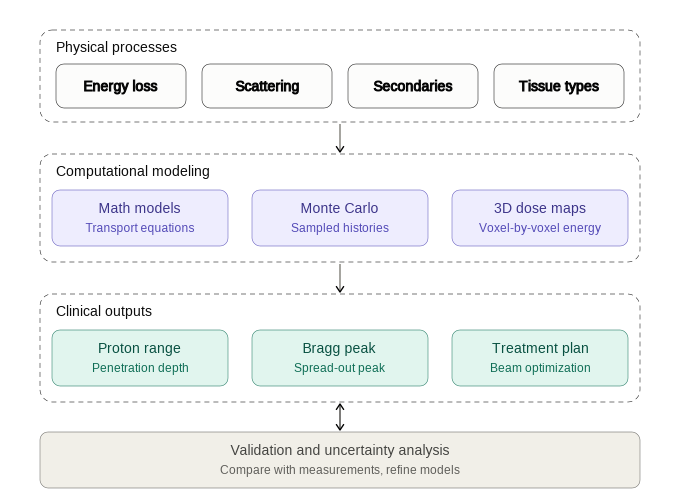
Advanced particle transport modeling and radiation dose distribution systems are essential components of contemporary proton radiation research and treatment engineering.
By combining mathematical transport equations, Monte Carlo simulations, experimental dosimetry, and three-dimensional anatomical modeling, researchers can investigate the complex behavior of energetic protons within biological materials.
A detailed understanding of stopping power, penetration range, multiple scattering, nuclear interactions, and energy deposition provides the scientific foundation for evaluating proton radiation systems.
Continued developments in computational physics, experimental validation, and medical engineering will contribute to the advancement of increasingly sophisticated radiation treatment technologies.